
Project management7-minute readPublished April 26, 2026
Written by the Construction AIM team, a general contractor holding an RBQ licence
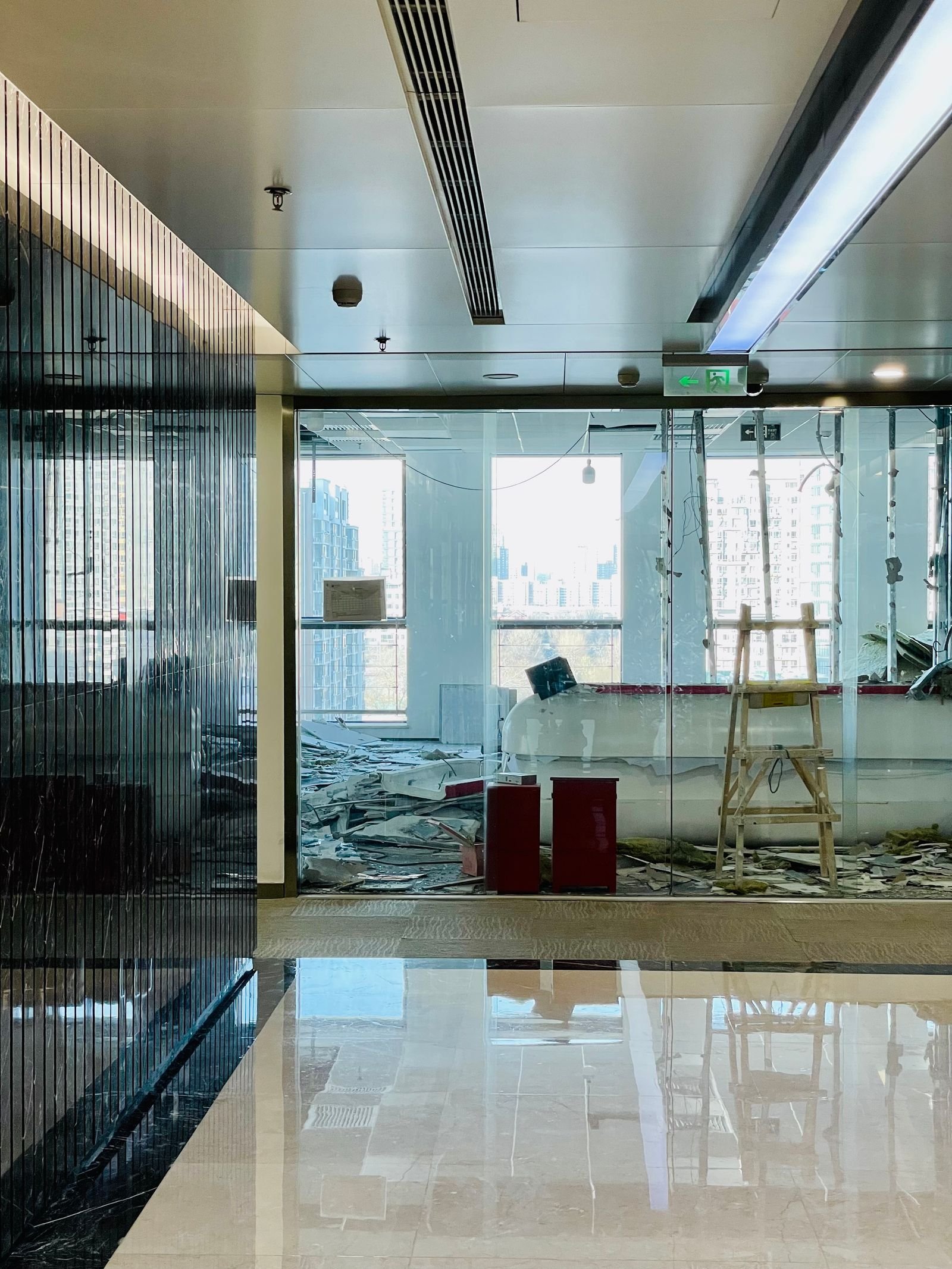
Redoing a roof above offices that are open for business, opening ceilings in an apartment building or redesigning a floor while the others keep running: work in an occupied building takes more than a good construction plan. Occupants have to be protected from dust, noise has to be limited, air quality has to be monitored and everyone has to be kept informed. Here are the measures that make the difference.
Work in an occupied building: what changes
On an empty job site, dust and noise are the crew’s business. In an occupied building, they affect employees, tenants and visitors who did not choose to be there. The ventilation system can carry dust from one floor to another, and a shared corridor becomes both an emergency exit and a path for debris.
The law also specifies who is responsible. Under the Act respecting occupational health and safety, the principal contractor is the owner or the person responsible for carrying out all of the work on the job site. The principal contractor coordinates health and safety measures and has general responsibilities that include public safety, site access and fire protection.
Planning before the first hammer blow
Identify asbestos and lead. Before any ceiling or partition is stripped, the presence of asbestos is checked. The regulations enforced by the CNESST require buildings constructed before February 15, 1990 to be inspected for sprayed-on materials, and those constructed before May 20, 1999 to be inspected for heat-insulating materials. A material that may contain asbestos is presumed to contain it until an analysis shows otherwise. Sampling analyzed by an accredited laboratory settles the question before anything is opened; lead in old paint is also detected through analysis.
Divide the job into phases. We determine which areas will be closed, for how long, and how occupants will get around. Targeted demolition, limited to the areas that require it, is less disruptive than stripping everything.
Targeted demolition, limited to the areas that require it, is less disruptive than stripping everything.
- 1990buildings constructed before February 15: inspection for sprayed-on materials required
- 1999buildings constructed before May 20: inspection for heat-insulating materials
- 99.97%of 0.3-micrometre particles captured by a HEPA filter
Plan the routes. Material deliveries, debris removal, equipment parking and, if needed, lifting from the outside: everything is planned to avoid lobbies and elevators at peak hours.
Containing dust
- Dust barriersThe work area is isolated with sealed partitions, in polyethylene or rigid panels, with a zipper door or an airlock at the entrance.
- Negative pressureAn air scrubber with a HEPA filter (a filter that captures at least 99.97% of 0.3-micrometre particles) draws air out of the contained area. Air therefore flows from the occupied areas toward the work area, not the other way around.
- Protecting the ventilationReturn air grilles located in the work area are sealed off and the system is adjusted so it does not draw dust toward the occupied floors.
- Source controlFor materials that contain silica (concrete, masonry, mortar), the CNESST requires measures such as wet methods, capture at the source and respiratory protection for workers.
- Daily housekeepingSticky mats at the exits, HEPA vacuuming, and debris bagged before it crosses common areas, then disposed of at an authorized site.
Managing noise and vibration
In Montreal, the hours allowed for construction work vary by borough; some even distinguish residential areas. These hours are a legal limit, not a target. In offices, the noisiest operations (demolition, drilling into concrete, cutting) are often grouped before employees arrive, in the evening or on weekends, depending on what is allowed and agreed with the property manager.
The choice of methods also matters: wet cutting produces less dust, and targeted manual stripping causes less vibration than heavy demolition. Announcing a noisy day in advance also makes a big difference in how occupants experience the work.
Monitoring air quality
The SMACNA guidelines on air quality in occupied buildings under construction group the measures into five families: protection of the ventilation system, source control, interruption of contamination pathways, housekeeping and scheduling. It is a good checklist to make sure a site plan does not leave anything out.
When the work involves moldy materials, for example after a roof leak, decontamination follows a recognized method such as the IICRC S520 standard, with containment and HEPA filtration. Air quality tests and an inspection before the ceilings are closed then confirm that the area can be closed up.
Communicating with occupants
A communication plan comes down to a few elements:
- a written notice before the work begins, with the areas affected and the expected duration;
- a schedule of noisy operations and of those that shut off a service (water, electricity, elevator);
- a contact person who can be reached during work hours;
- clear signage at entrances, with detours and the exits that remain open;
- a simple way to report a problem: odour, dust, noise outside the allowed hours.
How Construction AIM works
- Visit and assessment. We note how the premises are occupied, the access points, the ventilation and the sensitive areas.
- Detailed quote. Dust barriers, protection of access points, the communication plan and the management of disturbances are listed as work included, along with the technical and administrative exclusions and the terms.
- Testing before stripping. We have asbestos and lead screened through sampling and analysis by an accredited laboratory. If their presence is confirmed, their removal is covered by a change order approved in writing before it is carried out.
- Coordination with the engineer. When shoring or signed and sealed plans are required, we follow the documents of the client’s engineer, a member of the Ordre des ingénieurs du Québec (OIQ).
- Compliant execution. Work carried out according to the Quebec Construction Code, CNESST rules and municipal by-laws, with an air quality check before the ceilings are closed when the situation calls for it.
- Acceptance. Final walkthrough, cleaning of the common areas and handover of the premises.
Frequently asked questions
Does the building have to be evacuated during the work?
Not necessarily. Good containment, negative pressure and careful phasing often allow occupants to stay. Temporary relocation may be recommended for some areas, however, for example during major decontamination or for more vulnerable people.
Who is responsible for safety on the job site?
The principal contractor, meaning the owner or the person responsible for carrying out all of the work. The principal contractor coordinates health and safety measures and also looks after public safety. It is best for the contract to state clearly who plays this role.
How do you know if there is asbestos?
Materials that may contain it are presumed to contain it until proven otherwise. Representative samples are taken and analyzed by a laboratory before the work. The building’s asbestos safe management register, when there is one, also provides information.
Can you work evenings or weekends?
Yes, when the borough by-law allows it and it has been agreed with the property manager. These hours are planned from the quote stage, because they affect the schedule.
How much do these measures cost?
Our prices are based on the current wage rates of the Commission de la construction du Québec (CCQ), set by the collective agreements for the sector concerned (residential, institutional and commercial, industrial), plus the materials and equipment specific to each job. Each quote is free, detailed and prepared after a site visit, and the measures specific to an occupied building are described separately.
Let’s talk about your project
Do you manage a commercial building, a condo or an apartment building and need work done without closing the premises? We prepare a free, detailed quote after a visit, in Montreal, on the North Shore, including Laval, and on the South Shore.
Do you manage a building or sit on the board of a condo syndicate? See our services for condo syndicates and property managers.
For a store, offices or an institutional building, see our commercial and institutional work.
Scope of this guide. This content is general in nature. It does not replace a site visit or the opinion of an engineer or another professional about a specific building. The scope, price and conditions of any work are set out only in a written quote.