
Roofing7-minute readPublished November 6, 2025
Written by the Construction AIM team, a general contractor holding an RBQ licence
When it is time to redo the flat roof of a commercial building, two options often come up: a TPO membrane or SBS modified bitumen. Both keep a flat roof watertight in Quebec, but they differ in composition, installation, colour and maintenance. Here is how to choose between a TPO and an SBS membrane for your building.
Two families of membranes
TPO membrane (thermoplastic polyolefin) is a single-ply synthetic membrane. It is called thermoplastic because it softens when heated and hardens as it cools. Its seams are therefore welded with hot air, which fuses the two sheets into a single material. It is generally white.
SBS membrane is a bitumen membrane modified with a rubbery polymer, styrene-butadiene-styrene (SBS), which makes it flexible. On a flat roof, it is usually installed in two plies: a base ply, then a cap sheet covered with granules that protect the bitumen from the sun.
TPO or SBS membrane: the differences that matter
| Criterion | TPO membrane | Two-ply SBS membrane |
|---|---|---|
| Number of layers | One | Two (base and cap) |
| Seams | Hot-air welded | Torch-welded, or bonded without a flame depending on the system |
| Colour | White, reflective | Granules in various colours; reflective white granules available |
| Weight | Lightweight system | Heavier, because of the two plies of bitumen |
| Repair | Patch welded with hot air | Patch of compatible membrane |
| Strong point | Reflectance, uniform welds | Redundancy of two plies, puncture resistance |
Neither is better in absolute terms: it all depends on the building, the roof structure, how the roof is used and municipal requirements.
Installation: hot air, torch or torch-free methods
TPO is installed without an open flame. Depending on the system, it is mechanically fastened to the deck (the wood, steel or concrete surface under the insulation), fully adhered, or held by induction-welded plates. The seams are welded with a hot-air welder, then checked one by one.
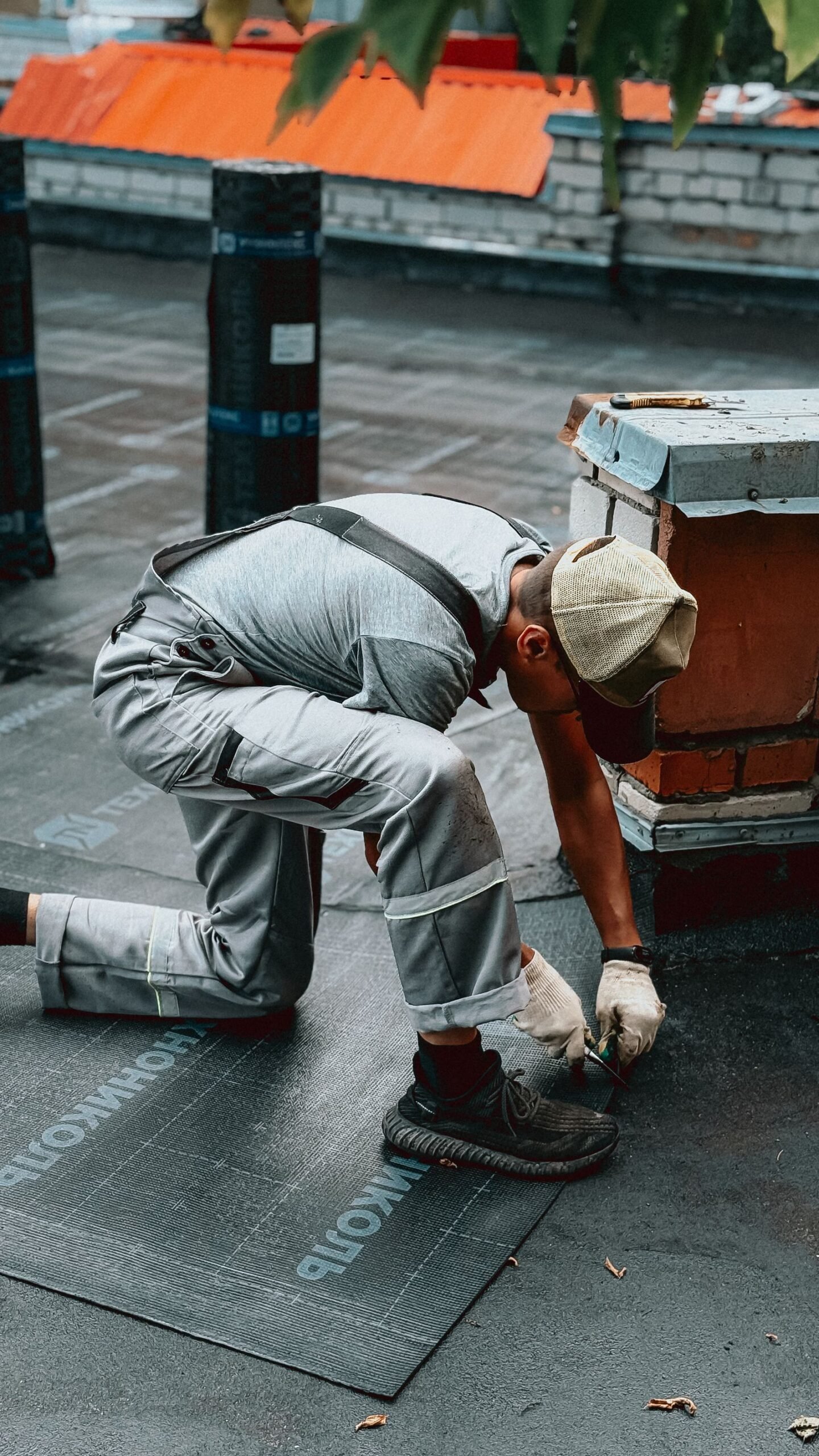
SBS membrane is traditionally installed with a torch, a flame that melts the underside of the membrane to bond it. Manufacturers also offer torch-free systems: self-adhesive membranes, cold-applied adhesives and hot-air sealing. These solutions are designed to reduce fire risk and suit buildings where an open flame should be avoided, such as heritage buildings or those with a wood deck.
Torch work is hot work: it requires a fire watch during and after the work, because a fire can smoulder inside a hidden material.
Quebec climate: frost, snow and foot traffic
A flat roof in Quebec goes through freeze-thaw cycles, heavy snow loads, ice around the drains and wide temperature swings.
- SBS membraneThe two-ply system provides redundancy; if the cap sheet is damaged, the base ply keeps protecting the roof. Manufacturers highlight its resistance to punctures and thermal shock.
- TPOIts performance depends mainly on the quality of the welds and of the details at the upturns (where the membrane turns up onto parapets and equipment). Since there is only one layer, protection against punctures is important: walkway pads for servicing mechanical units, care during snow removal.
In both cases, the design of the system (insulation, slopes toward the drains, flashings, wind uplift fastening) matters as much as the membrane.
White roofs: what Montreal requires
In Montreal, several boroughs require certain materials when a flat roof is redone, in order to reduce urban heat islands. Requirements vary by borough, type of building and nature of the work. According to the City, accepted options include:
- a white material, painted white or covered with a reflective coating or white gravel;
- a material whose solar reflectance index (SRI) meets the threshold set by the borough: at least 78 in several boroughs, including Ville-Marie, and 66 or 56 in others;
- a green roof, or a combination of these solutions.
- SRI 78minimum required in several boroughs, including Ville-Marie
- 66 or 56SRI threshold in other boroughs
- 1 or 2layers: single-ply TPO, two-ply SBS
The SRI measures a surface’s ability to stay cool in the sun: the higher it is, the less heat the roof builds up. These requirements do not apply to the part of the roof occupied by mechanical equipment or a terrace.
White TPO meets this type of requirement. SBS can also qualify with a cap sheet with reflective granules, for which some manufacturers advertise an SRI above 78. We check the product data sheet and the borough’s rule before ordering.
Maintenance and durability
The life of a roof depends mostly on the installation, the drainage and the maintenance. For both membranes, an inspection in spring and fall is good practice:
The life of a roof depends mostly on the installation, the drainage and the maintenance.
- cleaning the drains and strainers (the grates that hold back debris);
- checking flashings, counter-flashings and caulking;
- inspecting the upturns around mechanical units and skylights;
- for TPO, a visual check of the welds; for SBS, spotting granule loss and blisters.
How to choose for your building
- Old or wood structureTPO, installed with hot air, or SBS installed with a torch-free method.
- Roof with heavy traffic(equipment, maintenance): two-ply SBS offers a reserve against punctures; TPO requires walkway pads.
- Borough requiring a high SRIWhite TPO or SBS with certified reflective granules.
- Structure with limited capacityA lightweight system, approved by the structural engineer.
How Construction AIM works
- Visit and survey: condition of the existing membrane, the deck, the drains, the parapets and the equipment.
- Two options if needed: for the same roof, we can quote a TPO version and an SBS version, with the same tapered insulation and the same flashings, so you can compare on an equal basis.
- Detailed quote: tear-off, insulation, membrane, flashings and counter-flashings, drains, technical and administrative exclusions, terms and schedule.
- Coordination with the client’s engineer when the roof structure needs to be checked or reinforced.
- Execution in accordance with the Quebec Construction Code, CNESST rules and municipal by-laws; extras approved in writing before they are carried out.
- Payments based on progress; for commercial projects, a 10% holdback released at acceptance.
- Written warranty based on the type of work and the system chosen.
Frequently asked questions
Which membrane lasts longer?
Both can provide long service if they are well designed, installed and maintained. The details (upturns, flashings, drains) often matter more than the type of membrane.
Can a flat roof be redone in winter?
Work is possible in cold weather, within the temperature limits set by the manufacturer of each product. Snow, ice and moisture on the deck do make installation harder, though. We plan the schedule around the weather.
Does my roof have to be white?
It depends on your borough and the type of work. Several Montreal boroughs require a white, reflective or green roof covering when a flat roof is redone. We check the applicable requirement before proposing a product.
How much does a TPO or SBS roof cost?
Our prices are based on the current wage rates of the Commission de la construction du Québec (CCQ), set by the collective agreements for the sector concerned (residential, institutional and commercial, industrial), plus the materials and equipment specific to each job. Every quote is free, detailed and prepared after a site visit.
Do you need a permit to redo a flat roof?
In Montreal, most major flat roof replacements require a permit, while small maintenance repairs generally do not. The permit is obtained by the owner or coordinated with us; it is not included in our quotes.
Let’s talk about your project
Comparing a TPO membrane and SBS modified bitumen? We visit your roof and give you a free, detailed quote, with both options if needed. We work in Montreal, on the North Shore, including Laval, and on the South Shore.
For a store, offices or an institutional building, see our commercial and institutional work.
Scope of this guide. This content is general in nature. It does not replace a site visit or the opinion of an engineer or another professional about a specific building. The scope, price and conditions of any work are set out only in a written quote.