
Roofing7-minute readPublished September 27, 2026
Written by the Construction AIM team, a general contractor holding an RBQ licence
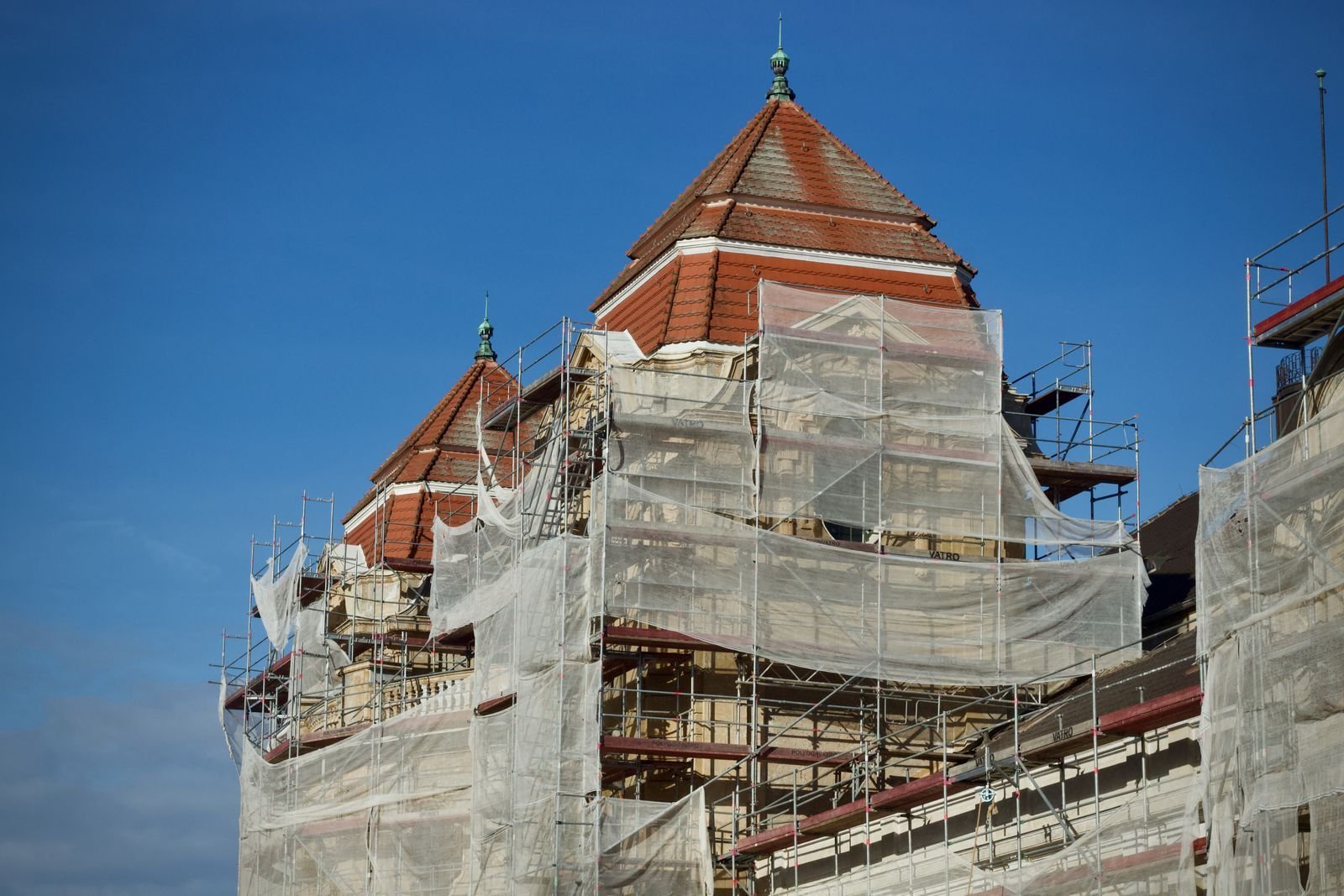
Re-roofing a heritage building is not just a matter of replacing a membrane. An old wood roof structure, period materials that may contain asbestos, a protected status and, often, occupied offices under the roof: each of these shapes the method. Here are the points to plan so that the work protects the building instead of putting it at risk.
Re-roofing a heritage building is not just a matter of replacing a membrane.
What makes a heritage building different
On the roof of an old building and just below it, you often find:
- Tired wood structureA wood structure and deck that have been through decades of leaks.
- Old tar and gravelAn old tar and gravel system, meaning several layers of felt and bitumen covered with gravel.
- Parapets and skylightsSkylights, masonry parapets and mechanical equipment added over the years.
- Insufficient slopesDrainage slopes that are too shallow and let water pond.
These conditions guide three key decisions: how the membrane is installed, how the roof structure is shored and how hazardous materials are handled.
Re-roofing a heritage building: which authorizations?
The building’s status determines who must approve the work.
- Building that is classified, located in a classified or declared heritage site, or in a protection areaThe Cultural Heritage Act requires an authorization from the Minister of Culture and Communications for the work concerned; for a classified building, this includes altering, restoring or repairing it. Old Montreal, for example, is a declared heritage site, where the City has also exercised certain powers since 2018.
- Building cited by the municipalityThe rules come from municipal regulations.
- Area of heritage interestSome boroughs require approval under a site planning and architectural integration program (PIIA). The planning advisory committee then reviews the project, and the borough council approves or rejects it, which can take a few months.
In Montreal, authorization requests for a heritage building go through the borough’s permit counter. These steps come before or alongside the permit application: it is best to build them into the schedule from the start.
Why torch-free installation is preferred
The traditional installation of an SBS membrane uses a torch, whose flame exceeds 1,000 °C according to one insurer. On an old wood roof structure, the risk is real: a combustible material hidden under a flashing or in a cavity can smoulder, then catch fire long after the roofers have left. For hot work, the Montreal fire department (Service de sécurité incendie de Montréal) requires a fire watch during the work and for at least 60 minutes afterward, plus a final inspection 4 hours later. One major insurer even recommends a watch of at least 3 hours after the torches are turned off on roofing sites.
Torch-free solutions reduce this risk at the source:
- 1,000 °Ctemperature a torch flame can exceed, according to one insurer
- 60 minminimum fire watch after hot work, in Montreal
- 4 hoursbefore the final inspection that follows this work
- Heat-welded TPO membrane: the seams are welded with hot air, without an open flame. The system is lightweight and its welds can be inspected visually.
- Torch-free SBS membrane: self-adhesive membranes, cold-applied adhesives or hot-air sealing. Manufacturers present these systems as suitable for historic buildings and wood substrates.
Shoring the roof structure
After years of leaks, joists or beams can be weakened, while the job adds loads: materials, workers, equipment. Temporary shoring supports the structure during the tear-off and the re-roofing.
On this type of roof, the shoring follows a structural plan signed and sealed by the engineer hired by the client, a member of the Ordre des ingénieurs du Québec. Before the work starts, it helps to get a note from the engineer that specifies the area and the method for stripping the ceilings, along with the shoring plan. If structural reinforcement is needed (joists, beams, columns), it is designed by the engineer and priced once the plans and specifications are received.
Materials are often lifted by crane. In Montreal, occupying the public road with equipment, a container or a site fence requires a temporary occupancy permit for the public domain.
Asbestos and lead: identify before tearing off
In an old building, many materials can contain asbestos. The CNESST lists in particular asphalt roofing felt, asphalt shingles, joint compounds, plasters, pipe insulation and sprayed-on materials. In Quebec, a material is considered to contain asbestos at a concentration of 0.1% or more.
The Safety Code for the construction industry requires employers, before starting work likely to release asbestos dust, to identify the types of asbestos present in the materials. In practice, representative samples are taken and analyzed by a laboratory before stripping. For lead, found in some old paints, the CNESST indicates that a composition test can be done before renovation or demolition work.
If the analysis confirms the presence of asbestos, removal follows the safe work methods required by the CNESST (containment, respiratory protection, waste management). This part is planned and approved separately.
Tapered insulation and drainage
Re-roofing is a chance to correct the drainage. Rigid tapered polyisocyanurate insulation, of varying thickness, rebuilds the slopes toward the drains and improves the roof’s thermal resistance. A cover board goes over it before the membrane is installed. Flashings, counter-flashings and caulking are redone at the parapets, on the masonry and around the skylights, then the drains are cleaned and flow-tested.
How Construction AIM works
- Visit and assessment of the roof, the top-floor ceilings and the access points, with the client’s engineer’s report.
- Detailed quote, often in two versions (heat-welded TPO or torch-free SBS), with inclusions, technical and administrative exclusions, terms and schedule.
- Asbestos and lead screening included before stripping; removal is excluded unless stated in writing and, if their presence is confirmed, it is covered by a change order approved in writing.
- Shoring according to the engineer’s signed and sealed plan; reinforcement priced separately once the engineer’s plans and specifications are received.
- Occupied building: dust barriers, protection of access points, noise management and coordination with the occupants.
- Targeted demolition of ceilings, limited to the areas needed.
- Execution in accordance with the Quebec Construction Code, CNESST rules and municipal by-laws; payments based on progress and, for commercial projects, a 10% holdback released at acceptance.
Frequently asked questions
Is torch installation prohibited on a heritage building?
Not necessarily, and requirements vary from one building to the next. The fire risk on an old wood roof structure is still a good reason to prefer a torch-free method, which the building’s insurer or the engineer’s specifications may also require.
Who handles the heritage authorizations?
The owner submits the application, and we coordinate the necessary technical documents with them. Municipal permits and authorizations are not part of our quotes.
Can occupants stay in the building during the work?
Often, yes. The work is concentrated on the roof and on targeted areas of the top floor, isolated by dust barriers, and noisy work is scheduled with the occupants.
How much does it cost to redo the roof of a heritage building?
Our prices are based on the current wage rates of the Commission de la construction du Québec (CCQ), set by the collective agreements for the sector concerned (residential, institutional and commercial, industrial), plus the materials and equipment specific to each job. Every quote is free, detailed and prepared after a site visit.
What happens if the wood deck is rotten under the old roof?
The additional deck to be replaced is only visible once the old roof is torn off. We document the affected area, the engineer confirms the solution if needed, and the replacement is approved in writing before it is done.
Let’s talk about your project
Do you manage a heritage building whose roof needs to be redone? We visit the property and prepare a free, detailed quote after the visit. We work in Montreal, on the North Shore, including Laval, and on the South Shore.
Does your building have heritage status? See our work on heritage buildings.
Scope of this guide. This content is general in nature. It does not replace a site visit or the opinion of an engineer or another professional about a specific building. The scope, price and conditions of any work are set out only in a written quote.