
Interiors7-minute readPublished April 4, 2026
Written by the Construction AIM team, a general contractor holding an RBQ licence
A roof leak, a leaking skylight or water damage that was not dried properly, and mold settles into ceilings and walls, often out of sight. Mold remediation is not just a matter of cleaning a stain: the source of water has to be fixed, the area contained, the affected materials removed and the result verified. The IICRC S520 standard is the reference for each of these steps.
Why mold appears after a leak
Molds need three things to grow: water or excessive moisture, nutrients and a suitable temperature, between 10 and 40 °C according to the CNESST. Drywall paper, wood and dust provide the nutrients; the leak provides the water.
Drywall paper, wood and dust provide the nutrients; the leak provides the water.
Time works against you. Fact sheets from Quebec’s health network recommend drying the premises within 24 to 48 hours after water damage; beyond that, mold can grow if materials stay soaked. And a slow leak, through a flashing or a roof drain, can wet a ceiling for months before anyone notices.
What the IICRC S520 standard provides
ANSI/IICRC S520 is an American procedural standard for professional mold remediation in buildings; its fourth edition dates from 2024. It can be required as a reference in remediation specifications. For dwellings, the Quebec standard BNQ 3009-600, published in 2020, also governs investigation and decontamination; it is voluntary.
The S520 describes three conditions:
- Normal ecologyCondition 1The normal fungal ecology of a similar building, with a few settled spores.
- Settled sporesCondition 2An area contaminated mainly by spores or fragments that come from a Condition 3 area.
- Actual growthCondition 3Actual mold growth, active or dormant, visible or hidden.
- 24 to 48 hto dry the premises after water damage, according to the health network
- Condition 1the state that remediation must restore, according to the S520
The goal of remediation is to return the affected areas to Condition 1.
Its main principles: protect workers and occupants, document each step, fix the moisture problem, physically remove the contamination inside a containment, then verify the result. Physical removal is the primary method; a chemical product or a « sealing » paint does not replace removal.
The steps of mold remediation
- Assess and fix the source. We find where the water is coming from and stop it: waterproofing repairs, flashings, drains. Without this step, the mold will come back.
- Screen for asbestos and lead. In an old building, the ceilings and partitions to be opened may contain them. Samples are analyzed before any stripping.
- Contain the area. Sealed polyethylene partitions, an entry airlock and sealed ventilation grilles keep spores from migrating to clean areas.
- Set up negative pressure. An air scrubber with a HEPA filter, which captures at least 99.97% of 0.3-micrometre particles, draws air out of the contained area so the spores cannot escape.
- Remove the affected porous materials. Contaminated drywall, insulation, ceiling tiles and carpet are cut back to sound material, bagged inside the containment and disposed of.
- Clean the remaining surfaces. HEPA vacuuming and wiping of the structure, the non-porous surfaces and the wood elements that can be kept.
- Dry. The materials kept must return to a normal moisture content before being closed up.
- Verify. Visual inspection, moisture checks and, depending on the case, air quality tests, before the ceilings and walls are closed.
- Rebuild. New drywall, joint finishing, primer and paint.
Protecting workers and occupants
Inhaling spores can cause respiratory irritation, coughing, headaches or worsening asthma. Older people, pregnant women and people with respiratory diseases, allergies or asthma are more vulnerable.
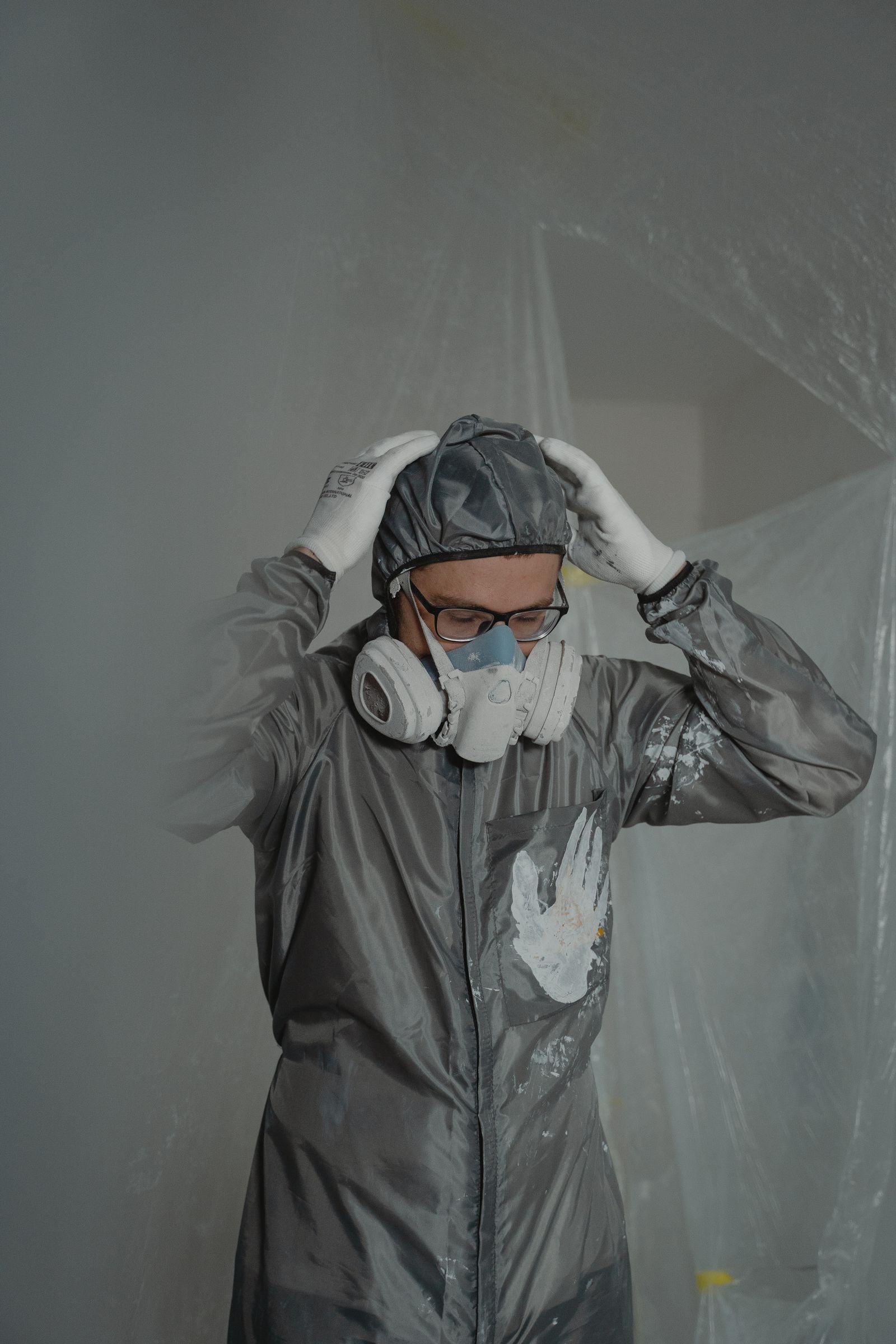
For workers, the CNESST recommends disposable nitrile gloves and an N95-type respirator. Depending on the scope of the work, a full-face respirator with an N100 or P100 filter may be needed, and protective clothing is indicated beyond 10 m². For occupants, containment and negative pressure are the first lines of protection; temporary relocation may be considered for the affected areas.
Air quality tests: useful, but not an end in themselves
The Institut national de santé publique du Québec (INSPQ) points out that there is no reference value for mold in indoor air and that air sampling cannot be used to assess health risks for occupants. Visible mold and excessive moisture are better indicators. Health Canada recommends cleaning up any mold growing in a home, whatever the species.
Air tests still have their place at the end of the work. The S520 calls for post-remediation verification, ideally by an indoor environmental professional independent of the contractor. Combined with the visual inspection, these tests help confirm that the area can be closed up.
When to call in professionals
In its fact sheet for the public, the Centre hospitalier de l’Université de Montréal (CHUM) advises calling a specialized company when mold covers more than one square metre or is suspected inside a wall or ceiling. A roof leak, an occupied building or old materials to be opened are other good reasons to hand the work to a team that knows containment and CNESST rules.
How Construction AIM works
- Visit and assessment. We locate the source of moisture, the likely extent of the damage and the constraints of occupancy.
- Detailed quote. Fixing the source, containment, negative pressure, HEPA vacuuming, removal of affected materials, air quality tests and restoration of finishes are detailed, along with the exclusions and terms.
- Screening before stripping. Asbestos and lead are screened by an accredited laboratory; any removal is covered by a change order approved in writing.
- Remediation under IICRC S520 and CNESST rules. A management plan for contaminated materials, protection of workers and occupants.
- Verification before closing. Air quality and mold tests before the ceilings are closed again.
- Restoration and acceptance. Drywall, joints, primer and paint, then a final walkthrough and a written warranty based on the type of work.
Frequently asked questions
Can mold simply be treated with a product or a paint?
No. Under the IICRC S520 standard, physical removal of the contamination is the primary method; a product or sealant does not replace it. For surface cleaning, the CNESST recommends water and soap or detergent rather than bleach.
Does affected drywall always have to be removed?
Drywall is a porous material: once colonized, it cannot be cleaned reliably. Health network fact sheets recommend throwing out porous materials damaged by water, such as drywall, insulation and carpet.
How long does remediation take?
It depends on the area, access, occupancy of the premises and drying time. The schedule is in the quote, and the final verification determines when the area can be closed up.
Who does the air quality tests?
Ideally, an indoor environmental professional independent of the contractor doing the remediation, as the S520 provides. The samples are analyzed by a laboratory.
How much does mold remediation cost?
Our prices are based on the current wage rates of the Commission de la construction du Québec (CCQ), set by the collective agreements for the sector concerned (residential, institutional and commercial, industrial), plus the materials and equipment specific to each job. Every quote is free, detailed and prepared after a site visit.
Let’s talk about your project
Has a leak left traces of mold in your ceilings or walls? We assess the source, the extent of the damage and the method to follow, then prepare a free quote after a visit, in Montreal, on the North Shore, including Laval, and on the South Shore.
Do you manage a building or sit on the board of a condo syndicate? See our services for condo syndicates and property managers.
Scope of this guide. This content is general in nature. It does not replace a site visit or the opinion of an engineer or another professional about a specific building. The scope, price and conditions of any work are set out only in a written quote.