
Foundations7-minute readPublished March 9, 2026
Written by the Construction AIM team, a general contractor holding an RBQ licence
A basement that smells musty, white marks at the bottom of the walls, or water after every heavy rain: these signs often point to a drain that no longer does its job. Replacing a French drain in Montreal means excavating, sometimes getting permits, and coordinating the work carefully. Here is how to tell that a drain has reached the end of its life and how the job unfolds.
What does a French drain do?
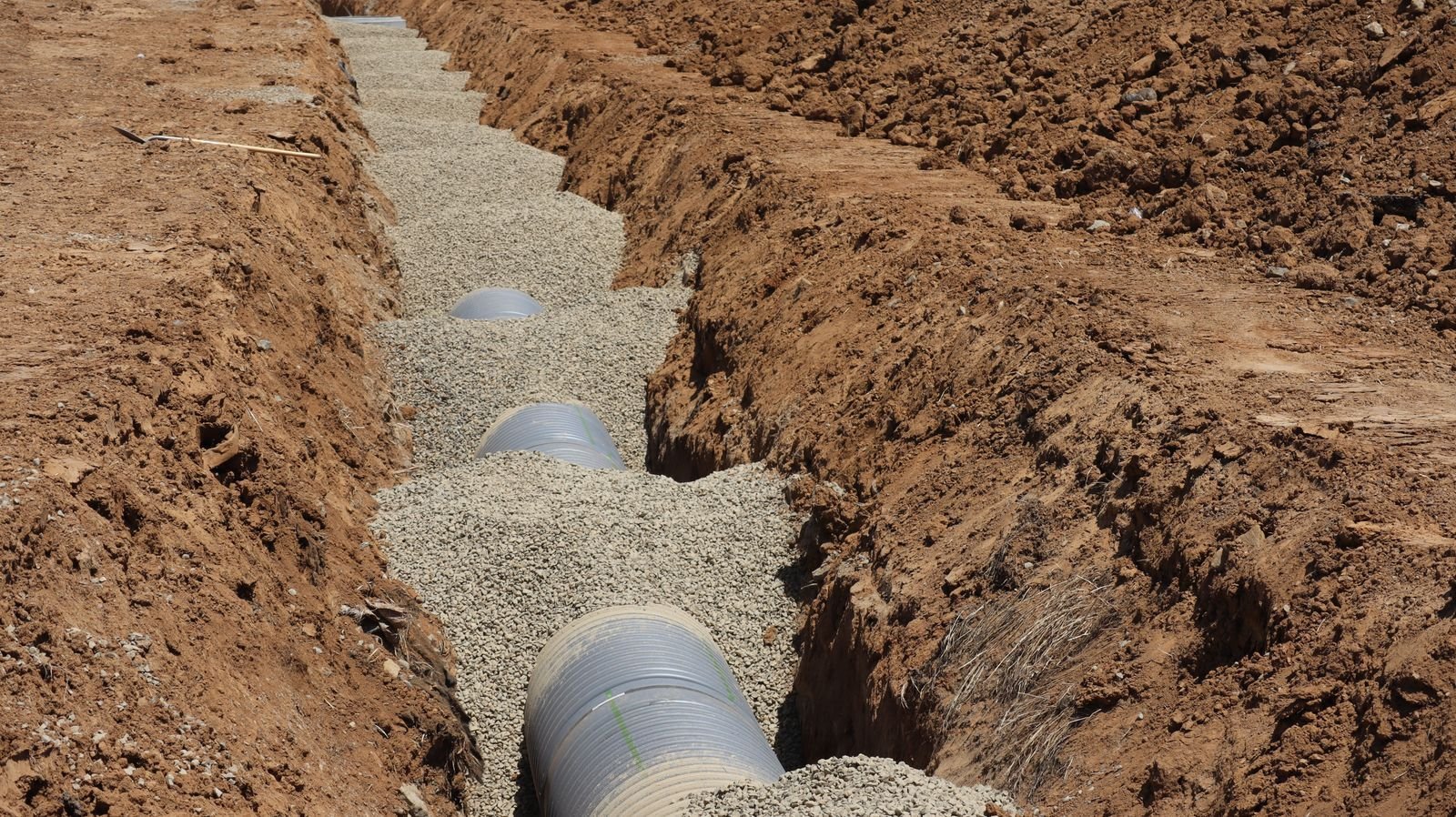
A French drain, or foundation drain, is a perforated pipe laid around the building at the level of the footing (the wider concrete base that carries the foundation wall). It collects water from the soil before it builds up against the walls and carries it to a sump pit, also called a sump basin, connected to the sewer.
The Quebec Construction Code requires the sides and top of drainage pipes to be covered with at least 150 mm of crushed stone. Pipes are generally certified to a Bureau de normalisation du Québec (BNQ) standard, such as BNQ 3624-115 for polyethylene pipes used for foundation drainage.
When should you replace a French drain in Montreal?
Age is a first clue. The useful life of a drain is generally estimated at thirty to forty years. Older buildings may have a clay tile drain whose sections break over time, and some houses more than 50 years old have no drain at all.
Age does not tell the whole story. A newer drain can perform poorly if it was laid above the footing, with reverse slopes, or bedded in backfill with too many fine particles that eventually clog it. Signs to watch for:
- Humidity and condensationHigh humidity in the basement and condensation on the walls.
- Musty smellA musty smell or mold on materials at the bottom of the walls.
- EfflorescenceEfflorescence, a white crystalline deposit left by water passing through the concrete.
- Water infiltrationWater coming in, especially through foundation cracks.
- 30 to 40 yearsgenerally estimated service life of a French drain
- 150 mmof crushed stone on the sides and top of the pipe, under the Code
- 5%ground slope away from the building, over at least 1.5 m
The case of iron ochre
In some parts of Quebec, drains clog because of iron ochre, an orange, gelatinous deposit that forms when iron dissolved in groundwater oxidizes, most often through the action of bacteria. The deposit gradually plugs the perforations and can harden. A laboratory analysis of the water confirms the problem. There is no one-size-fits-all solution: the usual approach combines periodic cleaning with a design adapted to the problem when the drain is replaced.
Clean or replace: the camera inspection
Before any digging, a camera inserted through a cleanout (a vertical pipe that gives access to the drain from the surface) or through the sump pit shows the inside of the drain: blockages, roots, crushed or shifted sections, reverse slopes.
If the drain is intact but dirty, high-pressure water jetting may be enough. If it is crushed, broken, poorly positioned or missing, replacement becomes the lasting solution.
If it is crushed, broken, poorly positioned or missing, replacement becomes the lasting solution.
Permits and rules to follow
In Montreal, an excavation permit may be required to install or repair a French drain, especially when the excavation is close to the public domain (sidewalk, street). The thresholds and documents required vary by borough, and a temporary occupancy permit is added if equipment takes up space on the public road. Depending on the location, a heritage review or plans signed by a professional may also be required.
Other rules govern the job site:
- Underground utilitiesThe Régie du bâtiment du Québec (RBQ) asks that underground utilities be located through Info-Excavation (a free service) at least four business days before digging.
- ConnectionCity of Montreal By-law 11-010 requires the exterior drainage pipe to be connected to the sump pit with a non-perforated pipe.
- DownspoutsIn Montreal, they may not be connected to the foundation drain; the water must be directed to a permeable surface at least 1.5 m from the foundation.
- SafetyThe Safety Code for the construction industry requires the walls of an excavation to be shored, with specific exceptions.
Laval and the municipalities on both shores have their own requirements; some have the drain inspected before backfilling. The City of Montreal’s RénoPlex program can also help pay for replacing the foundation drainage of buildings with 1 to 5 dwellings, provided the application is accepted before the work begins.
How the work unfolds
- Preparation: locating utilities, protecting the property, removing fences that block access.
- Excavation around the perimeter down to the footing.
- Wall preparation: cleaning, removing the old drain, repairing cracks with mortar or by injection depending on their type.
- Drainage membrane such as Delta-MS, mechanically fastened to the wall: its dimples guide water down to the drain.
- New drain at footing level, bedded in clean stone, with cleanouts.
- Connection to the sump pit, existing or new, tied into the sewer.
- Backfilling in compacted layers, with a slope that carries surface water away.
How long it takes depends on the perimeter, the depth, access and the weather; the timeline is set out in the schedule that comes with the quote.
How Construction AIM works
Everything starts with a site visit. We carry out a visual and technical assessment of the foundation, the lot and the access points. If there is a structural engineer’s report, we take it into account and coordinate the work with the engineer.
You then receive a detailed quote that specifies:
- the work included: type of drain (rigid and BNQ-certified, or crushed stone wrapped in geotextile), Delta-MS membrane or equivalent, cleanouts, sump pit, backfill and a slope away from the building of at least 5% over 1.5 m;
- technical exclusions: landscaping, interior work, conditions not visible during the visit (contaminated, frozen or waterlogged soil, rock or shale, unstable old foundations), specialized pumping where there is a high water table;
- administrative exclusions: municipal permits, unforeseen municipal requirements, traffic signage fees;
- terms and schedule.
Permits are generally obtained by the owner or coordinated with them. The work complies with the Quebec Construction Code, CNESST rules and municipal by-laws. Any extra is approved in writing before it is carried out, payments follow the progress of the work, and acceptance of the work comes with a written warranty based on the type of work. Service details: foundation waterproofing and French drains.
Frequently asked questions
How much does it cost to replace a French drain?
Our prices are based on the current wage rates of the Commission de la construction du Québec (CCQ), set by the collective agreements for the sector concerned (residential, institutional and commercial, industrial), plus the materials and equipment specific to each job. Every quote is free, detailed and prepared after a site visit.
Can you replace only part of the drain?
Yes, if the camera inspection shows a localized problem and a drain in good condition elsewhere. If the drain is old all around the perimeter, a full replacement is often the safer choice.
Do you need a permit to replace a French drain in Montreal?
Often, yes: this work falls under the City of Montreal excavation permit depending on the depth and the distance from the public domain, and requirements vary by borough. Elsewhere, check with your municipality. Municipal permits are excluded from our quotes, but we coordinate the process with you.
Does a new French drain protect against sewer backups?
No. The drain handles the water in the soil. Backups come from the municipal sewer and are prevented with a properly installed and maintained backwater valve.
Let’s talk about your project
Is your basement still damp, or is your drain several decades old? Ask for a free quote, prepared after a site visit. We work in Montreal, on the North Shore, including Laval, and on the South Shore.
Do you own a house, a duplex or a triplex? See how we work with homeowners and plex owners.
Scope of this guide. This content is general in nature. It does not replace a site visit or the opinion of an engineer or another professional about a specific building. The scope, price and conditions of any work are set out only in a written quote.